by Nada Cory | Jun 29, 2020 | Travel Croatia
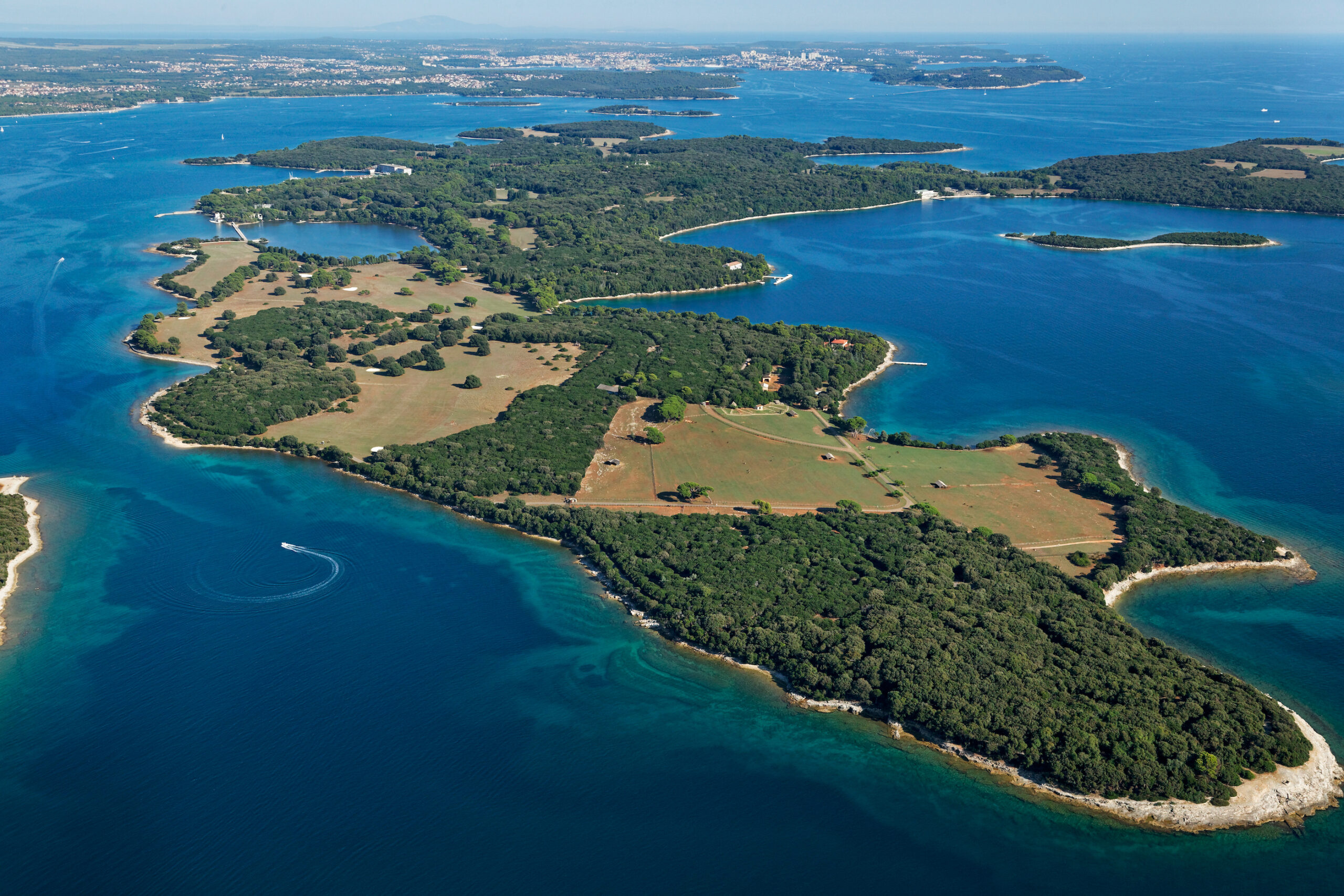
The Brijuni Islands are an archipelago group of fourteen small islands in the Croatian part of the northern Adriatic Sea. Separated from the west coast of the Istrian peninsula by the narrow Fažana Strait, lies the largest island, Veliki Brijuni, 2 kilometers off the coast.
Like most islands of the Brijuni archipelago, Veliki Brijuni has been settled since prehistoric times, with the earliest traces going back to 3000 BC (early Bronze Age). The Illyrians lived on the islands from around 1500 BC until Roman conquest in 177 BC, and their remnants of five Illyrian fortified hill forts were discovered here.
The most important Roman site on the island is at Verige Bay, where the ruins of a 1st century villa rustica, a luxurious summer residence, can still be seen. After the fall of the Roman Empire in 476, the whole area came under Ostrogoth control, and during the Gothic War in the 6th century the islands were taken over by the Byzantine Empire. In 1331 the Republic of Venice and its aristocratic families ruled the Island.
Veliki Brijuni has certainly carved out a place in history. It is a known fact that after World War II, the island was turned into Josip Broz Tito‘s luxurious summer residence. Tito used the island from June 1947 to August 1979 for entertaining a great number of foreign ministers, dignitaries and heads of state. Since 1984 a permanent exhibition titled Josip Broz Tito at the Brijuni is housed on the island, where visitors can see a gallery of pictures documenting famous visitors and heads of state from 60 different countries, entertained on the Island. Other notable guests who visited during that period include Gamal Abdel Nasser, Jawaharlal Nehru, Eleanor Roosevelt, actress Sophia Loren and the novelist James Joyce.
In 1978 a safari park was created on the northern part of the island, covering an area of 9 hectares. The park is used as home to a number of exotic animals, most of which were brought to Tito as gifts. These include Nilgai antelopes (given by Jawaharlal Nehru in 1959), the Kob antelope, Somali sheep , zebras, Indian Elephants and llamas.
To add another measure of scientific history, rare Dinosaur footprints were unearthed at the National Park in Veliki Brijuni. To illustrate the size of these Mesozoic creatures who left their traces upon the land, a full-scale reconstruction was fashioned by a scientists and artists, with great accuracy. When sailing into the port of Veliki Brijuni and leaving the boat, it is possible to see the three-toed print in the limestone block, probably left by large theropod carnivores!
For those of you who travel with host Nada Cory on any of the “Croatia and Beyond” excursions, expect a visit to amazing Veliki Brijuni, as we journey from the mainland by boat for a memorable day. Adventure, cool breezes, time for a lovely meal, and wonderous sights to behold, awaits us for the day!
by Nada Cory | Jun 25, 2020 | Travel Croatia
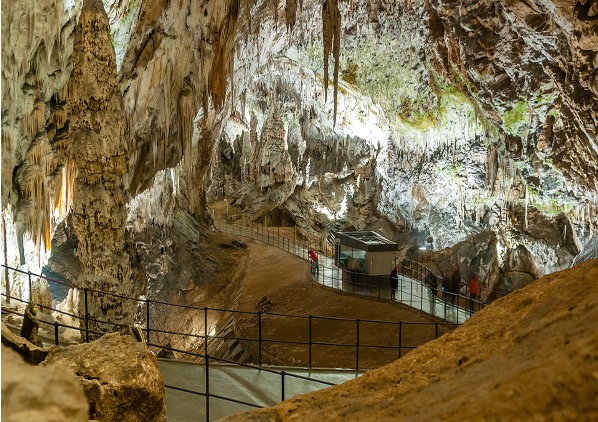
Postojna Cave is a long “karst” cave system near Postojna, southwestern Slovenia. Karst topography is formed by the dissolution of soluble rocks such as limestone, dolomite, and gypsum. It is characterized by underground drainage systems with sinkholes and caves, carved by the Pivka River. It has taken millions of years to create this natural wonder, replete with beautiful stalagmites, stalactites, and formations called draperies that resemble folded curtains. This cavernous system is 15 miles long (24.12 kilometers) long and consists of four interconnected caves through the identical underground river; joining two of the main cave systems will make this the longest in Slovenia, and one of the lengthiest in all of Europe.
The caves are also home to the endemic olm, the largest troglodytic amphibian in the world. Our expedition through the caves includes a visit to the aquarium where olms can be observed. On January 30, 2016, a female olm at one cave location began to lay over 50 eggs, a rare event that led to global news about Postojna Cave, and its existence.
The cave was first described in the 17th century by the pioneer of karst phenomena, Johann Weikhard von Valvasor, although graffiti inside dating back to 1213, indicates a much older history. In 1818, when the cave was being prepared for a visit by Francis I, the first Emperor of the Austria-Hungary, a new area of the cave was discovered accidentally by local Luka Čeč (who became the first official guide). In 1819, Archduke Ferdinand visited the caves; this is when the caves became officially known as a sightseer destination. Electric lighting was added in 1884, preceding even Ljubljana, the capital of Carniola, and further enhanced the cave’s splendor. In the 1850s, the Austrian-Czech geographer Adolf Schmidl published the first comprehensive scientific overview of the Postojna caves and the Pivka Basin, which became a standard reference point in the study of speleologie.
Spelunkers, get your cameras ready for an unforgettable experience!
by Nada Cory | Jun 24, 2020 | Travel Croatia
For those of you who are traveling with us on the June 2021 “Croatia and Beyond” journey, you will notice the addition of several new sites and dining venues.
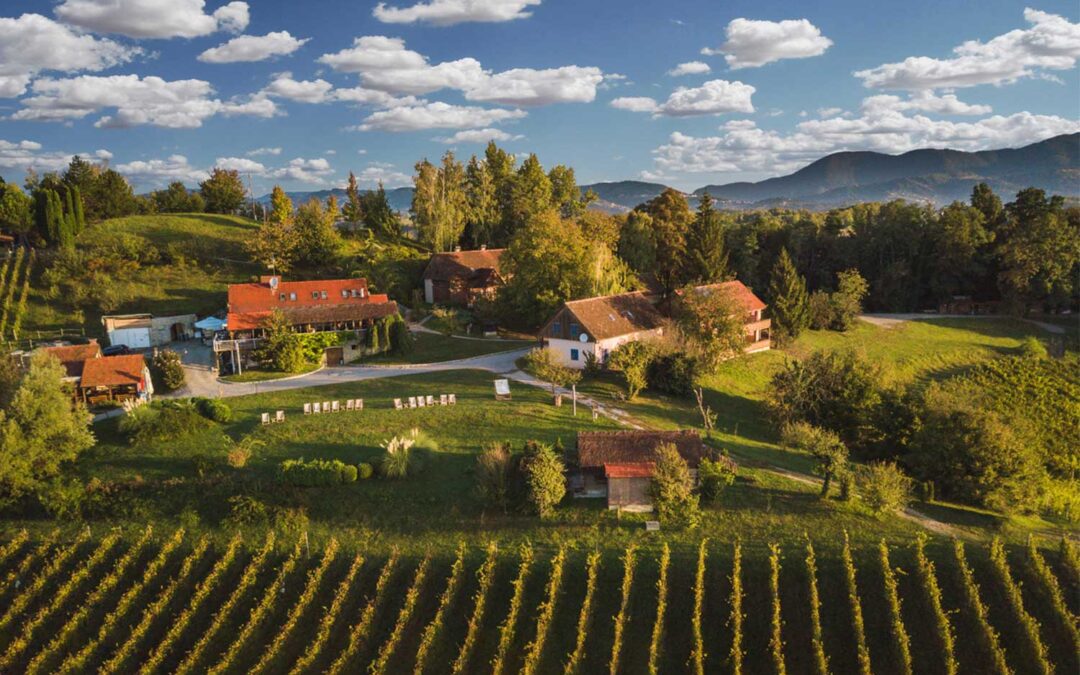
While in Kaprina for the day, we will visit ”Vuglec Breg”, the creative and romantic vision of the Vuglec family. The Vuglec family’s aim was to convert the heritage of their ancestral home, into a lasting legacy. Inspired by the desire to create a unique full circle experience, you will surely be immersed in the natural environment of Zagorje, a magnificently beautiful region of Croatia.
Inside the restaurant, decorated in traditional style, the atmosphere sets the perfect mood for a magnificent gastronomical event. Precious coveted recipes from “Grandma’s kitchen” have been resurrected, and add a touch of authenticity to specialties such as Grandma Roza’s bread, cottage cheese strudel, veal, lamb, duck, and turkey with mlinci.
”Vuglec Breg” was built on the foundations of the old Zagorje hamlet of ”Vuglec”. This Michelin mentioned estate stretches over 12 hectares, and from the hill’s peak, one can enjoy a magnificent view of the surrounding region, dotted with houses, cottages and churches.
Great to visit any time of the year, with fireplaces for a cozy feel, or on the summer terraced pergola (Pri baki Rozi), with its outdoor cooking amenities, positioned right along the vineyard. Let’s raise a glass and toast our latest culinary wonder!
by Nada Cory | Jun 22, 2020 | Travel Croatia
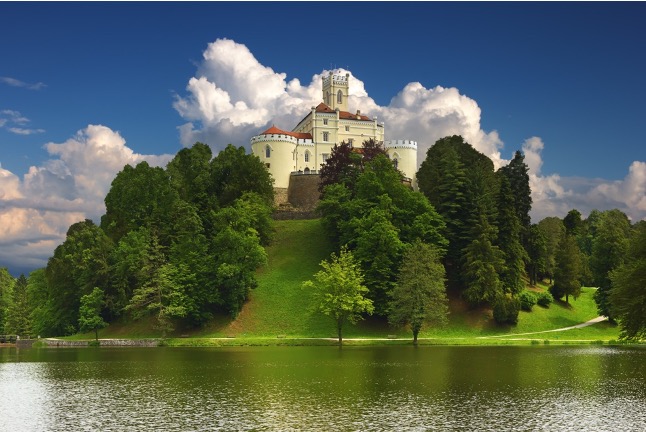
Trakošćan Castle is located in Varaždin county, northern Croatia, and dates back to the 13th century. Built as an observation fortress for monitoring the road from Ptuj to Bednja Valley, legend states it was named after the knights of Drachenstein, who were in control of the region in the early Middle Ages.
Although it is not known who its owners were in the first years of its existence. It has changed hands many times over. As the end of the 14th century approached, it was owned by the Counts of Celje, who was in charge of the entire area. This prestigious family soon became extinct, and Trakošćan shared the fate, as did the other burgs and estates that were endlessly divided, until it became neglected, falling into dilapidation.
It was only towards the middle of the 19th century that the family had a renewed interest in its estate, and in the Romanticist spirit of return to nature and family traditions, the castle was transformed into a residential manor-house with a beautiful surrounding park. The generations that followed occupied the castle from time to time all the way until 1944, when they were forced to emigrate to Austria. Soon after that, the castle became nationalized and has acquired its present appearance; a Neo-gothic style, which continues to receive ongoing upkeep and renewal.
Since 1953, the museum within boasts collections on permanent display, and today is owned by the Republic of Croatia. The castle itself reveals the various architectural phases of building, while the fortification’s observation tower overlooks stunning views.
I look forward to sharing this special stop on our pre-tour adventure!
by Nada Cory | May 26, 2020 | Travel Croatia
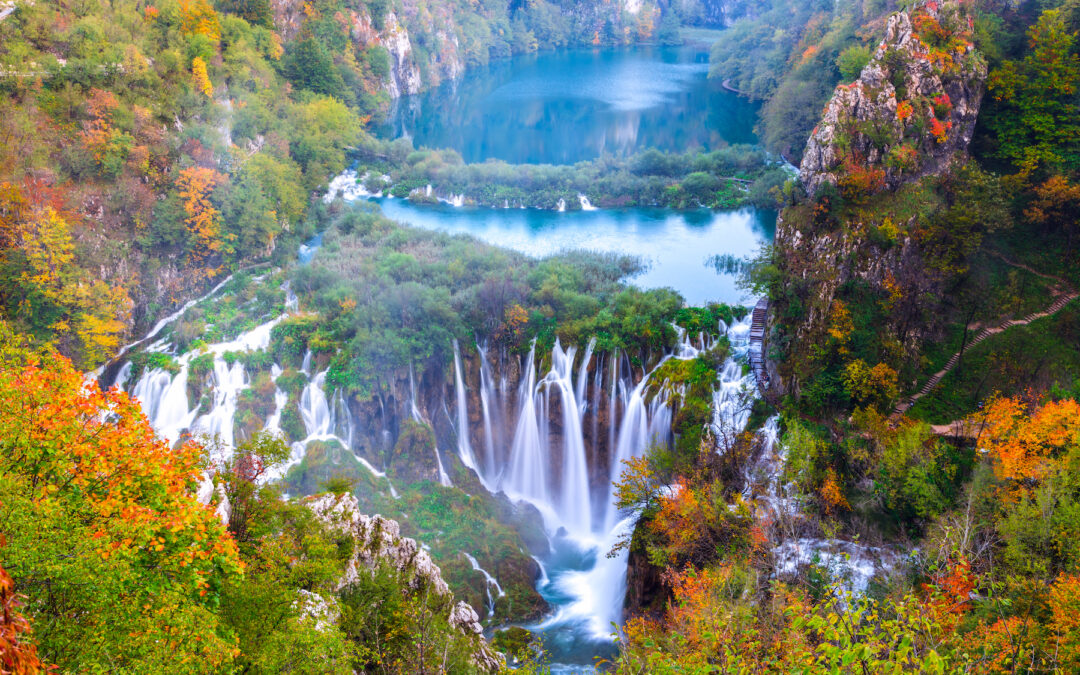
No trip to Croatia is complete without a visit to the oldest national park in Southeast Europe, Plitvice Lakes. You will be amazed as you gaze at its 16 interconnected lakes, and hear the sounds of humming waterfalls bounding across the wooden pathways surrounded by fir, birch and spruce trees. The lakes are famous for their stunning colors, which change from shades of teal, turquoise and dark blues, as a result of the high mineral content in the water. Each season brings you a unique stunning landscape worthy of any artist, or those who set their eyes upon it.
There are mysteries and legends surrounding this area, referred to on some maps as “The Devil’s Garden”. According to legend, the Plitvice lakes were created after a long drought. People, animals and plants, had yearned for water, and prayed and prayed for rain. Then in the valley of the Black Queen with her magnificent suite, she took pity on the people, and with the strong wind and thunder the deluge tumbled down at last. Rain kept falling and falling, and the water grew in great size, to form the Plitvice Lakes.
During our 2021 adventure to Croatia and Bosnia Pyramids, you will experience this first hand. You will relax on a boat ride around the lake, lunch in the park, and dine on fresh trout cooked for you lakeside, at a local specialty restaurant, in a nearby village.

by Nada Cory | Mar 10, 2020 | Travel Croatia
Smiljan is a village in the mountainous region of Lika in Croatia. It is located 6 km northwest of Gospić, and fifteen kilometers from the Zagreb-Split highway; its population is 417 (2011).
Smiljan is known best for being the birthplace of Nikola Tesla on 10 July 1856. Due to celebration of the 150th anniversary of the birth of electricity pioneer and inventor Nikola Tesla, Croatian officials opened a Tesla memorial complex, including a museum inside his restored childhood home. Today, Tesla’s birth house, together with the Orthodox church of St. Peter and Paul (built in 1765) and the surrounding area, represents a memorial complex with various exhibits of Tesla’s inventions and a museum where the details of the inventor’s life are shown.
There is also a congress hall in a nearby building. The original memorial complex was built in 1956. During the Croatian War of Independence, several of the buildings were severely damaged by fire. The Croatian authorities restored it and reopened it in a 2006 ceremony with the highest dignitaries of Croatia as well as Serbia.
Join us on our 2020 Croatian Pilgrimage, September 14 – 27, and visit many historic and interesting sites like this! A Bright Idea!